Sunday, July 24, 2011

Galilee- Day two and three!!

Day 2- While one class went on a field trip we stayed at the Kibbutz and had three hours of New Testament class, did a little homework, but mostly hung out at the beach. I was so tired and feeling anti-social so I watched the rest of the Harry Potter 7: Part one. I hear everyone in the states is excited for Harry Potter 7 part 2, and we might go see it here even, we’ll see. At night we had a bon fire and that was cool.

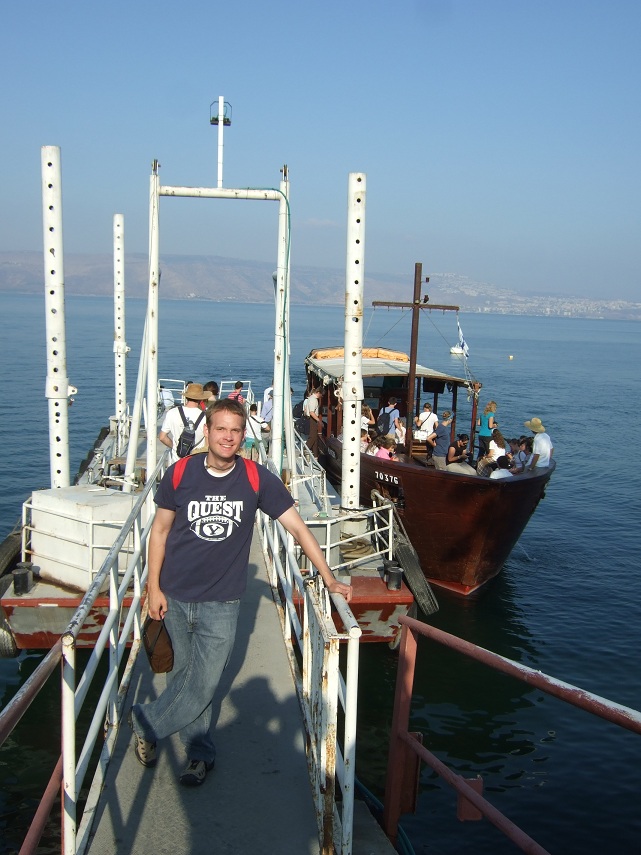
Day 3- Today was our turn to take a field trip. We first took a boat ride across the Sea of Galilee, then stopped in the middle and talked about Christ calming the storm as well as him walking on water. (Matt 14:24). We sung “Master the Tempest is Raging” as well as “Jesus Savior Pilot Me.” While we were in Galilee the wind always blew West to East; the “contrary wind” in the KJV of Matt 14:24 means the wind was going East to West, which caused them problems. Anyway, after a short devotional we went to the other side of the Sea to a place where they had this old boat they found on the beach which was from the 1rst century. We then headed off to the Mount of Beatitudes.

                So they never explained to us why they were so sure this place was the Mount where Christ taught in Matt 5. Probably because it is near Capernaum, and there are natural amphitheaters in the hillsides there. There is a neat modern church (made of Basalt) that is there with lots of nuns there taking care of it. There were stain glass windows with the beatitudes in Latin written in them, as well as very nice gardens surrounding the place. A nun there gave us a little talk in what I have to say was the most insightful teaching about the Sermon on the Mount I’d heard from someone non-LDS. We walked the grounds, and then did a little drive over to Capernaum.

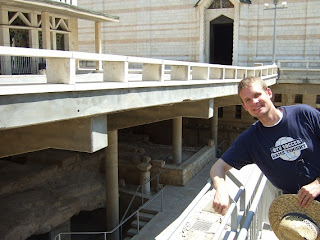
Capernaum was cool! Our teacher gave us a list of the many miracles Christ did there and there are a ton! This town was probably “church headquarters” in Christ’s day because Peter’s house was there and so many miracles happened and are recorded from there. We first went to a 3rd century white synagogue which was built on the foundation of a black basalt synagogue that was there is Christ’s day. The new synagogue basically has the same dimensions as the old one and it was really neat to visit. This is probably where Christ heals a man’s withered hand in Mark 3:1-6 or Luke 6:6-11. The synagogue was surrounded by the ruins of Capernaum. The streets were narrow and the buildings all made of black basalt stone. Rabbi’s always lived near the synagogue, and so one of those ruined houses near the synagogue would have been where Jairus and his daughter lived. (Matt 9:18-26, Mark 5:21-42). Also we know a centurion built that synagogue we were standing on (Luke 7:1-10)! About a hundred meters away there was a huge church built on columns so it stood above the ground. Below it lied the remains of three octagonal churches, the original having been built around a place where early Christians believed was Peter’s house. An early church would have met in a member’s house, and there is good evidence it was used as a church very early on, and was also venerated early on as a place where Peter lived, so there is a good chance that was actually where Peter lived! That also would have been where Christ stayed for much of his ministry! If it was his house we would have walked just as Christ did in Mark 1:29. Later on in Mark it appears people know that they kind find Christ at Peter’s House so that’s probably where Christ spent his time and where would have been the “church.”  Cool cool things.

We visited a few more places. One was Topka, where after his resurrection Christ cooked some fish for his disciples. (A church was built to commemorate the place.) Also a “Church of St. Peter’s Primacy” was built there to also commemorate where Christ told the disciples to cast nets on the other side of the boat also in John 21. A rock was there where supposedly Christ ate with them there. Oh hey, we also visited a bay that makes a natural theatre and apparently if you are right in the middle your voice can carry 8 times over. Probable spot for Mark 13:1-2.  We also went to an ancient Bethsaida, although one of our teachers doesn’t believe it is actually. Anyway, whatever it is there was a large fishing house found in it. James of John were from Bethsaida, so maybe they knew the people there is it was. Also it was an Old Testament town that fell I believe to the Assyrians.  After that we went home.

I want to take a moment and again remind whoever is reading this how neat it was to go to these places where teachings were given that really have had an effect on my life, especially the teachings of the Sermon on the Mount and the miracles and teachings in Capernaum. Love your enemies, consider the lilies, by their fruits ye shall know them, there are tons of teachings from here! Read Matt 5-7. Super cool. By the way, we know it would have been the rainy season because there were lilies in the field! We were there in the dry season, but it still looked green, kind of like how most of Yakima is brown but there are still green trees and green agriculture in the summer. There are just so many neat things that I love that happened near or on the shores of Galilee, not very far apart!

Sea of Galilee and the boat we took!

On the sea.

Ancient boat preserved in crazy chemicals from time of Christ.

View from mount of Beattitudes.

3rd century Synagogue built on remains of 1st century synagogue.

Houses of Capernum. Imagine Christ walking down this street. Also it was in  one of these houses Jarius lived.

St. Peter's house built under a church.

Bay of Parables (the lake is low at this time.)

Bethsaida. Because of the worship of idols here these gates would fall in the Assyrian invasion.

Saturday, July 23, 2011

Galilee- Day One (and the day before)

Well we got back from Galilee just a few days ago and there is a ton to report on! I’ve included scriptures so check them out! So get ready….

Note on school: The day before we left to Galilee we had a paper due at 1:00. I’m pretty sure I didn’t do as well as a job as I could have on it, but I think most other people probably did worse. We haven’t received our grades for those classes yet, so I don’t know how I did yet, but it any case I’m glad those classes are behind me. I think I made the most of them, but they were hard to deal with sometimes with all the other things to do here. Now the only classes I’m taking are New Testament and a continuation of my ancient near east studies class. Boy I’m glad those other classes are done. Anyway, we had a paper due at one so I spent the whole day writing it. We had a service project that I would have liked to have gone to but didn’t because of the paper. Anyway, after the paper was do me and two others left to walk over to West Jerusalem to an open air market and buy some dried fruit for the trip. We also walked around West Jerusalem looking for this clothing store that apparently donates money to charity if you buy a shirt. Sounds like a gimmick to me. Well, we looked for some ice cream too, couldn’t find what we were looking for, and eventually went back to the Jerusalem Center to pack and get ready for our trip to Galilee! I should mention that I watched half of Harry Potter 7 that night. I’ve been so busy I haven’t allowed myself to watch any movies while here, but I was so glad finals were over I did then. The next day we left bright and early to Galilee.

                Well, the first day of Galilee was fun! We first drove through the West Bank to see some scenery that we’d never see again, because we took a different route back. We first went to Bet She’an, also known as Scythopolis. Ancient cities were always built on hills for protection, but by the time of the Romans cities expanded and were built at the bottom of the hill. Thus was the case as in this city. The Egyptians and Canaanite ruins were on top of a hill and the Roman city ruins were below. In this part of the Holy Land basalt stone is more plentiful so the street was made of black basalt, although the other parts were made of Marble, in Roman Style. Basically the story of this place is that it was controlled by Egypt and/ or Canaanites for awhile until Joshua took it. Later, it was here where Saul and his sons were hung on the walls after they were killed at Mt. Gilboa (1 Sam 31:7-13). The men of Gabesh-Gilead, which is right across the Jordan Valley, then came and got the men off the walls. Other than that there was some ancient Egyptian carvings, some old mosaics, and lots of really big columns from Romans times there.

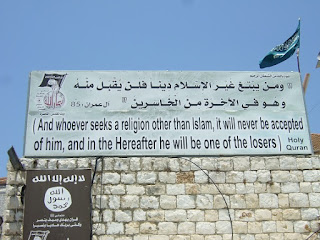
                We then drove through the more fertile areas in Northern Israel, through several valley systems including the Joknean Pass where in the novel The Kingdom and the Crown by Gerald N. Lund a fictitious battle takes place. We then arrived at Nazareth, where both Jesus grew up and Mary was announced to she’d be having Jesus. The Christians in Palestine have been having a rough time for many years. Nazareth used to be mostly Christian Arab but now is being replaced by Muslim Arab. There is a huge Christian church there, the largest in the Middle East, and Muslims wanted to build a mosque right by it and make it taller. There was such a controversy that eventually the Israeli government stepped in and said no mosque. Anyway, they still erected a big sign with a quote from the Koran that said anyone who doesn’t believe in Islam will be a looser in the afterlife. P.S. it actually used the word looser. When we were in Bethlehem a week before they also had erected a mosque right next to Nativity square, which when the call to prayer went off, it was so loud my hands jumped to my ears. I can’t help but imagine they made it so loud on purpose, just next to a Christian site to show a superiority of Islam over Christianity there. I’ve felt things like that have been on purpose and I find it unfortunate that it takes place.

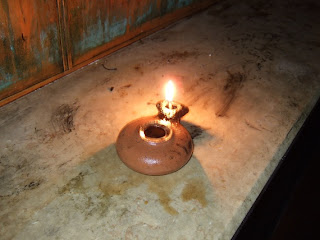
Anyway, so in Nazareth we went to this place where they have tried to re-create what life in Christ’s day would have been like. It was a little like how people dress up as pioneers at Nauvoo to show what life was like in early America. The people there had really clean clothes, but other than that it was nice to have a visual how things might have been, how people harvested grain, herded sheep, did carpentry, crushed wine, wove things, that sort of thing. Do you know why you crush grapes with your feet? It’s because if you use anything else you will break open the seeds and the juice will be bitter. I didn’t know that. They also had a exhibit that had a recreation of a Roman cross and armor, synagogue, as well as little lamps they used to have back then.  After that we went to a Christian church that was built upon the remains of an old synagogue. Thus it possibly may have been the site where Jesus announced he was Jehovah to the people of his village and where they tried to stone him. (Luke 4:13-30). The story of Christ being rejected by his own village has always been one that has touched me and made me appreciate the courage of the savior in doing what his father wanted even if it meant rejection by those whom he grew up with.

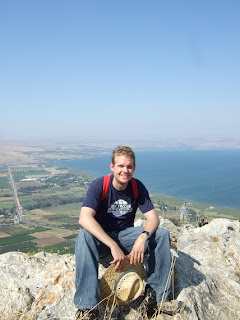
                After that we went to the Church of the Annunciation, built in commemoration of the angel announcing to Mary she’d be the mother of the son of God. AS I stated earlier, it’s the biggest church in the Holy Land with who huge levels, and a shrine that contains the remains of an older, more ancient church. The current church was a more modern church, owned by the Catholic Church, and had many art pieces donated from all around the world to adorn the inside and outside of the building. It was impressive. The monks seemed to know BYU faculty pretty well. After that we went to Mt. Arbel, which is right over the Sea of Galilee. From there we could see the whole valley; Migdal where Mary Magdalene was from (Migdal= Magdalene), Capernaum, and a lot more places we’d visit the next few days. It was an impressive site and it was exciting to stand above and see nearly all the places I’d read about so much of in the Gospels. Ever since I was younger I’ve entertained the thought of maybe someday going to BYU Jerusalem or just Israel and seeing all these things. I even made a list of things to do in my life in elementary and put on there to learn Hebrew (well, hey I did take a 1 credit class here!). What adds to the splendor of Galilee is that it’s pretty much undeveloped. With the exception of Tiberius, which is on the sea shore, and a few towns not directly on the sea shore, the place is unsettled, which gives views of hills, valleys, and a lake which can easily be imaged as that of Jesus. In other places of Israel there are either big cities around historical areas (like Jerusalem), or just plain empty deserts, but here in Galilee things are green and beautiful, and it’s so easy to imagine where the stories took place and what things were like. Our teacher told us the Israeli Government doesn’t allow for more building there, only on previously developed land, although we weren’t given an explanation of why; maybe to preserve the beauty of the place, maybe because it’s so close to the Syrian border.

                We then drove to the east side of the Sea of Galilee (also known as Lake Kinneret or the Sea of Tiberius in the NT) where we’d stay the rest of our time there. A Kibbutz there owns a beach resort in which we stayed. It was really nice, and the air conditioning worked great, which was important because it was hot and humid there! A kibbutz is a community based on socialistic ideals where basically everyone works and everyone shares from the profits. Back 80 years ago the Kibbutzes were very strict and sometimes people weren’t allowed to own anything, not even their own clothes. But now things are changing; just last year the kibbutz we stayed at changed a policy and allowed people to own their own houses, while still living on the Kibbutz. People at our Kibbutz, other than taking care of the resort, own cows, banana trees, and do fishing. The beach was a small strip of sand, although we got to go swimming because it was summer and things were warm enough. 
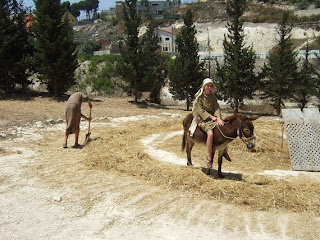
"Nazareth" village

Lamp. These were often put in Limestone niches to give light to a house. "Candlestick" in  Matt 5:15.

See blog for explanation.

On floor of the Church of the Annunciation

Some caves/houses from Christ's time down below me.

View from Mount Arbel over the Sea of Galilee. Should say "Beth Saida OR Bethsaida," not what it says.

Galilee!!

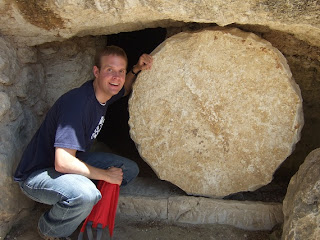
Re-creation of a tomb with a rolling stone.

Saturday, July 9, 2011

Some last thoughts after Bethlehem

Some notes about nativity: wooden mangers were not used in the time of Christ, wood was not used as a building material, it’s too rare and valuable here. Instead, stone mangers were used. (Imagine a small square stone with a dip in it.) Also, in this time, they didn’t grow hay for animals; they just let them graze, so there wasn’t any hay either in the manger: it was just used for water. Also in case you didn’t know they didn’t keep animals in wooden barns either, they would have used caves. The manger was also probably only used for donkeys or sheep. If it belonged to Joseph which our teacher believes it may have it would have just had a donkey. Also, If you’re wondering about wood and how Jesus was a carpenter if wood was rare, the answer is he wasn’t a carpenter. The Greek says he was a tekton, or a builder. And what was furniture and houses made of back then? Stone. So Jesus and Joseph were stone-masons. One more thing that may bust your bubble: have you ever seen a manger scene with a palm tree in it? Palm trees don’t grow in Bethlehem it’s a hill country, nor do they grow in Jerusalem. You see, most olive wood mangers are built by Muslim Palestinians. The Koran says Mary went out into the wilderness and gave birth to Jesus under a palm tree, hence the palm tree included in many manger scenes. Well now you know.

Another day of the week a few of us went out through Orson Hyde Garden to a Russian Orthodox church, as well as one or two other churches. Other than that we took a final, which I did very well on, and I’ve been studying for classes and writing another final paper for another class. I’m doing my best to balance being in Jerusalem, being social and doing homework. I decided at the beginning of this semester that I was going to do all my homework, which has made it hard to do the other two. Oh well, I guess I can’t expect everything to be perfect. Hey also the 8th this Friday we did celebrate the 4th a July with a BBQ. Maybe I haven’t had American food for a while but it was super good! Steaks, Kabobs, Chicken, Hot dogs, pecan pie. YUM!!!

I taught Elder’s quorum today; that’s always fun. There was a rumor Glen Beck was going to show up at church, cause he was in Israel, but he didn’t, something about security concerns. Also tonight at a fireside we had our Relief Society President, a convert to the Church because of a Palestinian scholarship brought her to do her masters at BYU. She lives in Bethlehem but can come to Jerusalem for church because she works for the United Nations now. But for years she didn’t. She grew up in the West Banks and went to Bethlehem University. She was there in 87 when the intifada broke out. One of her fellow students was shot trying to raise a Palestinian flag on top on the university. He laid there shot in the head in the University for two hours until they let a ambulance in. Anyway, she hated Israeli’s. However, she said after her conversion she returned to the West Banks expecting to be filled with that same hate. Surprisingly to her she wasn’t. She said she’d had a change brought upon her. After church a few of us went down to the “Garden of Gethsemane.” I use quotations because that phrase is not found in the New Testament. In the Gospels it says the disciples went to a place called Gethsemane (Olive Press), and he left his apostles there and went father to pray, taking Peter, James, and John with him. In the Book of John it says he went to a garden to pray. Anyway, my teacher thought it was important that there was a garden (olive orchard) near the olive press but that is wasn’t called by that name. ANYWAY, there was a place our teacher pointed out where there is actually a chapel built where there was found an ancient olive press just at the site in the Kidron valley where Gethsemane was! (Olive presses were underground, to protect the oil from the sun, so they weren’t just anywhere). So that was neat. They also had a “Tomb of Mary” nearby so that was cool too. Then we sweated our way back up the hill to the Jerusalem Center to eat dinner.

That’s about it for now. This week we’ll be heading up to north Israel to the Galilee and be spending nearly two weeks there. This is really the reason I came here, because of the New Testament. We’re 2/3 through and have 5 weeks left. I’m starting to feel worn out from all the learning, and we just finished the Old Testament (which P.S. is important to understand this land and all LDS scripture.) I hope to make the most of it. 
At Russian Orthodox church.

A panoramic view of an underground church that used to be an olive press where Gethsemane is.

Christmas on the 4th of July

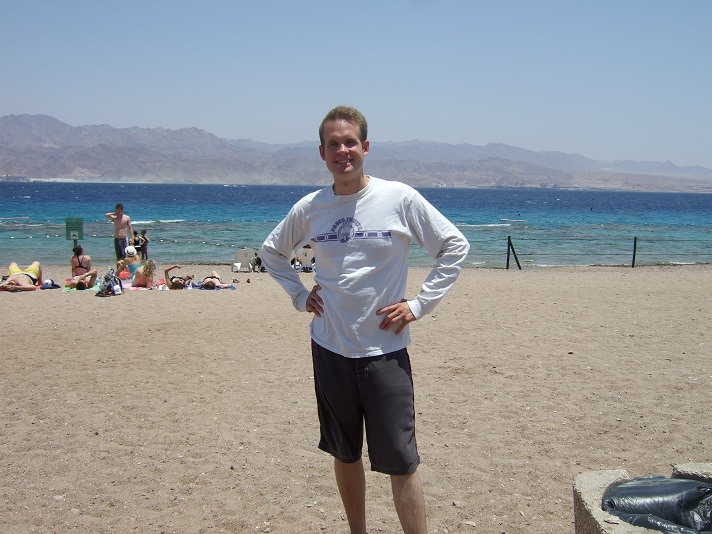
What a neat week! There are so many cool things that happened. First off, last Sunday we had a student organized activity, in which we all went down to the gulf of Eilat/ Aqaba, and went snorkeling. This whole weeks there has been tons of jokes asking if “Eilat” was “a lot” of fun. (Pronounced the same.) I must admit I was a perpetrator of these puns. Anyway, it was neat because we traveled down to the south of the land of Israel through the Negev desert, stopping at Oasis that have been there for thousands of years. We know that Lehi traveled this same way because he reports that his family went down and traveled “on the borders near the red sea”. We could see just that area across the sea into Jordan. Rest stops have been built around those oases and so it’s probable that the same places we stopped, Lehi stopped. We got up early in the morning and took a bus down (no teachers!) and we all rented snorkeling gear and got into the water. We only had enough for half of us so we took turns but it wasn’t much a problem because there was a stronger current and a wind and you got tired pretty easy. But I easily spent 2 or 2.5 hours scuba diving total. Most of the coral or cool fishes were about 15-20 feet down so I did a lot of diving, while popping my ears half way so I could swim down. I wouldn't say it was the best scuba-ing on earth but it was something I’ve only had the opportunity to do once before so it was really fun. There were still lots of colorful fishes, and neat reefs. By the end I was so tired I could hardly swim- that’s when I knew it was time to go back to the beach. Afterward we drove a half hour north to a Kibbutz (communal living community based off of socialist ideals where people share everything) that was very famous for its dairy and milk cows and we had dinner there. Afterwards we had ice cream (sold in a separate place from the rest of the food.) Anyway it was a great day.
The next day was super neat. That would have been the Fourth of July. We visited some appropriate sites for the dates as well, as I will explain. The first site was the Herodian, the hilltop fortress of Herod the Great and subsequent Herods. Apparently earlier in his life he was being chased by Hasmoneans trying to kill him, and at that some point his old mother almost died, so when he came out victorious he built that fortress to commemorate it. To do it he basically took the top off a nearby mountain and built up that one. Some people say he was paranoid, but he had reason too, he was very hated by the people of his day. It’s surprising how much of this fortress, along with the palace that he built, that still remain. A huge artificial lake about the size of two Olympic size swimming pools with an artificial island in the middle still stands, along with tons of rooms from his palace, not to mention the gigantic fortress he built on top of the hill. I have some amazing photos. Also I learned how to paste several photos together with windows photo viewer so I may include some of those. Also there was underground tunnels built by Jewish zealots when they took the fortresses, built to try and surprise attack Roman soldiers in the tunnels. It didn’t work out too well for them.  This is the third gigantic fortress of Herod we’ve visited: one in Jordan, one in Jericho, and this one outside Jerusalem. At the first one we visited I was really surprised at the opulence of it, this one was even more opulent. Herod taxed the crap out of his people, and while they lived in super small little hovels, he was living in humungous pleasure palaces. Even the temple he built was the largest temple complex in the known world at the time, according to one of my teachers. Anyway, it was appropriate to visit the destroyed fortress of a tyrant on the Fourth of July. Our teacher told us a story about a guide in Egypt who asked “what do you do in America when the president won’t leave office?” As much as they tried to explain it to him, he couldn’t understand that American presidents do leave office when they’re done. America is great.

After that we crossed over into Bethlehem which is in the West Bank (only a few miles outside Jerusalem) and visited Bethlehem University. It’s a Catholic sponsored school but is attended mostly by Muslims. Its kind a symbol of Palestinian Nationalism since during the intifadas students protested and were killed there. We watched a propaganda movie, then we got to ask students there questions, and then have time to also talk to the students. It was neat.

After that we went to lunch at this restaurant that was designed like a Bedouin tent with pillows and such. The food was really good. Outside there was a man selling little cheap nativities made of olive wood. They were small but much cheaper than anywhere else in Bethlehem. (Bethlehem shops-> expensive.)
After that we went to the Church of the Nativity, the oldest Christian church in the Holy Land. It’s situated in Bethlehem where the original Bethlehem was, and below there is a grotto which would have been used to hold animals. So if Christ was not born in this grotto then it was one nearby. All other Christian churches in the area were destroyed by the Moslem conquest, but they saw depictions of the wise men like Persians from their part of the world and decided not to destroy it. However, the church has been rebuilt or changed several times.

Afterwards we went to a little field outside of Bethlehem, a place the Jerusalem Center calls Shepherds’ Fields, where we could see Bethlehem in the background, and fields where shepherds still tend their flocks. (You can see the poop and wool lying around.) There weren’t shepherds there at this time but there was one guy who wanted a dollar to pet a lamb. It was a really neat little field that has gone undeveloped because it’s right on the border between the West Bank and a Jewish Settlement. Anyway, it was nice to sit there, ponder, and learn a little about the site. Of course we know that Christ was born at Bethlehem, we also know David grew up there and he himself was a shepherd. He for sure would have had his sheep grazing at one point in the field. Also he slew a lion somewhere in the vicinity (back when lions lived here). We had a devotional where we sung Christmas songs. It was really neat to ponder and reflect what happened in a small village those many years ago, with the modern one sitting in front of us. I came away from that with a new appreciation for pilgrimage and the Holy Land. Up to this point I’d looked at the Holy Land as a place other people were fighting for or wanted. Many Jews have the attitude “Jerusalem is ours and it belongs to us” and same with many Muslims in the area. I came away thinking “Hey Jerusalem is mine too! It doesn’t belong to any one religion or people, but shared by many.”

It was appropriate to visit Herod’s Palace as well as Bethlehem that day. One was a place where an earthly King reigned with opulence and corruption, unjustly ruling over his subjects. The other was a place where the King of Kings was born, but in very humble circumstances in a manger, but who would rule justly. The two were quite a contrast really, and I think this was one of my favorite days in Jerusalem. We had a testimony meeting on the bus on the way back to the center, which was also a good experience.
At Eilat.

Herod's Gigantic Swimming pool. That structure at the tip of my arm is  the artificial Island.

Ali and I with the Herodian behind us.

This is plaster on a stone made to look like stone to save money.

Inside the Herodian fortress remains. I used "panoramic" option to paste several photos together.

Church of the Nativity.

Entrance to the church of the Nativity.

Traditional place where Christ was born. There is a fourteen pointed star there  to represent the fourteen generations between David and Jesus. This is my teachers family by the way.

Bethlehem in the back. Church of the nativity in the upper left of the picture.

Saturday, July 2, 2011

Orson Hyde Park

The rest of the week I spent a lot of time getting ready for our finals. I took a Hebrew language final, an Old Testament final, a field trip final, and next week will take both the Israel and Palestinians finals. But I think the worst is over. Tomorrow we’ll be going to down to Eilat by the Gulf of Aqaba to go snorkeling. It’s supposed to be the best snorkeling in the world. After that we’ll be going to Bethlehem for the Fourth of July! I’ve learned quite of bit of things about Bethlehem but I think I’ll save those for next time. Hey a pretty good movie that we watched here was The Nativity which was put out in like 2006 or something. Shows a good job of portraying the people at the time, I believe.
One last thing that happened today; I got up this morning at 7 to go walk to Orson Hyde Park with other students. It’s really quite amazing that the church has been able to make a footprint in the Holy Land; Orson Hyde Park is right across the valley from the temple mount. The church does not own the park; however did pay to have it built and it has the name of the park in front. I was thinking about it and if it wasn’t for the conflict here we’d probably not have the buildings and programs here we do. In East Jerusalem, because the politics there are complicated because it used to belong to Jordan, the church was able to build the Jerusalem Center there on a lease for the land (because no one else will build there). Anyway, it was neat to open up to Luke 22 and read about the Mount of Olives and know I was right there where Christ prayed to his father. I also saw the biggest spider I’ve ever seen, about the size of my palm. I also saw a huge ant with wings. Anyway, we walked down Orson Hyde Park, and then visited the church of all nations where they have some really old Olive Trees where I’ve talked about before in my blog.
Orson Hyde was an early church leader who traveled 18 months to reach Jerusalem and dedicate it for the preaching of the Gospel. He and the other missionaries didn’t have much success, and one or two even died here. They told us a story in the MTC about how because the graves of those missionaries were found here we could show the LDS church has had a presence in the holy land for a least a hundred years, allowing us to qualify building in Jerusalem. I’m not sure if it’s true but sure a good story huh? Well, today we can’t preach here, we’ll see what the future holds.
Veiw from Orson Hyde Park.

Holocaust Museum

Next day we went to Yad Vashem, the holocaust memorial here in Israel. From what I understand it was a fairly light museum as far as the Holocaust is concerned. I’d never been to one before but other students had. This one focused more on Jews who fought back, like in the Jewish Warsaw Ghetto Uprising. It also focused on anti-Semitism before the war and a little after. In fact there was only one room on concentration camps, which is usually the focus of other holocaust memorials.
While Israel was formed in 1948, the Zionism and the groups which started the state came before. Zionism was the belief that Jews could no longer be treated fair or equally by being part of society, so had to start their own. The Israeli War of Independence was fought by these Zionist settlers. After WWII, when holocaust survivors started immigrating, they were actually looked at negatively, as a group that didn’t fight back. Over time that view has changed in Israel, but was pervasive for many years. Holocaust survivors didn’t talk much about their experience either., which contributed to the phenomena.
The tour was guided by our Judaism, Zionism, and the State of Israel teacher, an orthodox Jew, Dr. Ophir Yarden. After than we talked about secular Zionism.  It’s hard to explain to Christian Americans. Basically being a Jew is more than religion. Secular Zionists are people who king of take a religious ideology to their secular-ness, I suppose. SO holidays in some parts of Israel have become secularized, but still celebrated.  For instance, our teacher told us a parable: a man named David brought an item of religious significance to the top of a mountain in order to unite his people. DO you know who it would be? Most would think of King David bringing the ark to the temple mount to unite his kingdom and the tribes. However, our teacher explained how David Ben Gurion, first prime minister of Israel, brought Herzl’s body to Mt. Herzl in Jerusalem to unite religious and secular Jews. He said the mountain by the Holocaust museum was sort of a holy of holies for secular Zionism. Well if you’re confused that’s OK. It was like a 3 hour lecture explaining it all. Part of that tour was the huge military cemetery there, like the Arlington cemetery of Israel. Anyway, after that we went home.
There arn't many pictures you feel like taking at a Holocaust Museum. The statue behind is a picture of Jewish Freedom fighters.

This Mural respresents the people thrown out of Europe. People from both orthodox and secular groups are depicted.
I wish I had something to say about the holocaust, except that it was a horrible thing. I can’t say I enjoyed the museum. I think we need to remember it can happen again, if not to the Jews than other groups. I liked the Israeli museum because it put the holocaust in perspective of anti-Semitism throughout time. I think we need to be careful about our own prejudices. My mother told me a statistic about how a certain percentage of Americans would not vote for a Mormon for president simply because of his religious convictions. Not that that is anyway like the Holocaust, but the same hatred/ prejudice that existed against the Jews before WWII (and even today) I think is directed on a lesser scale towards people like Mormons. I just think we need to be careful about our prejudices towards certain groups.

It's fun to go to the YMCA!

Last Sunday a group of us started out by going to the Temple Mount, and walking around there for awhile. Then a few of us went to where some say the upper room was where the savior introduced the sacrament to his disciples. I guess we can’t know for sure but it may have been there (also the upper room was N.T. church headquarters!) Down below there was a Jewish Synagogue or at least shrine where many believe King David was buried. Then we walked into West Jerusalem and visited the YMCA building and tower. It was built to represent the religious traditions of the land, and reflects Islamic, Christian, as well as Jewish decorations. Our branch president, a professor of organ instruction at BYU, plays the bells there every Sunday. As such he allows us to come up and watch him, and even lets us play the bells if we want! So, naturally, I practiced on the practice organ Hymn 72: Praise to the Lord, the Almighty. The bells are hooked into an instrument kind of like a piano but with fewer keys, but that are large and to play you strike them with your whole hand. It was neat because those bells can be heard clear across Jerusalem and even over at our center. So my little hymn was heard by many. I guess all those years of piano lessons paid off. Also there was a girl in our group who played the Harry Potter Theme song. Another girl played who took the bell performance class at BYU and was able to play very well. The YMCA allows us to play Hymns or other songs, just not hymns associated with the restoration. That was probably the highlight of the day.
                After eating some pizza on one street in West Jerusalem (no meat on it of course (kosher)) and after eating the lunch I packed as well and grabbing some ice cream, a few of us went to this Scottish church south-west of the Old city. Not much except you could see the difference between the Scottish protestant church and other Catholic or Orthodox churches (a lot plainer- more like LDS chapels). I believe it was built in commemoration of some fallen Scottish soldiers.
After walking through an artist’s colony west of the city, we found some taxi drivers and bargained for a tax ride home. The driver’s name was George like as in Saint George, who slayed the dragon. He was a Palestinian Christian who lived in the old city. An interesting guy to talk to, although he didn’t speak much English. He just mentioned something about Islam killed a bunch of people so he’s Christian. Reminded me of some simpler minded people I met on my mission.
Brother Ohman our branch president playing the bells in the YMCA bell tower!

YMCA tower power. (A veiw from the top of the tower._

It's fun to go to the YMCA!

Me and the Big Corny.

Great Scottish Church!